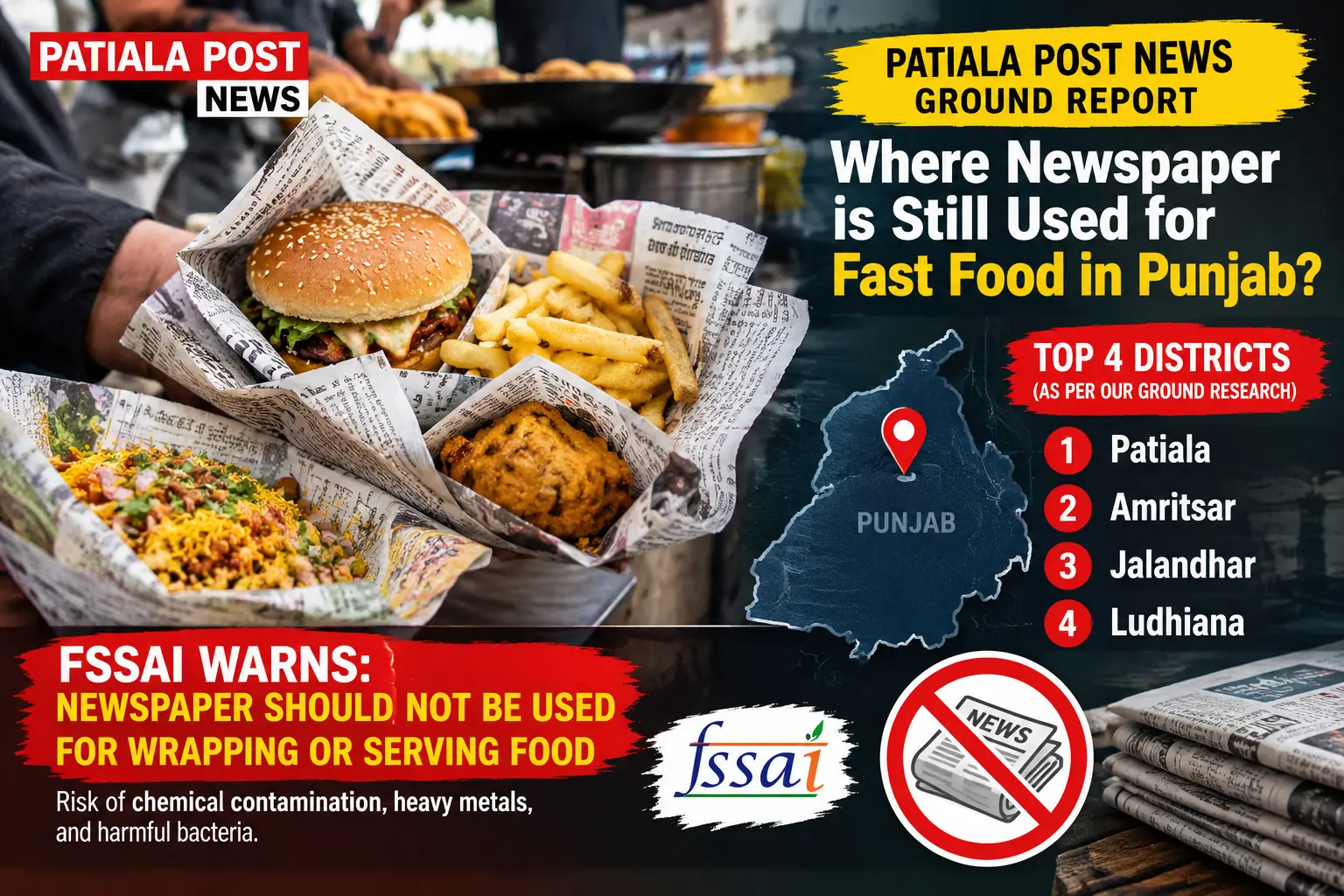
Patiala: A ground-level investigation by Patiala Post News has highlighted a widespread food-safety practice across Punjab that continues despite clear regulations against it.
In its exclusive ground research into food-serving and packaging practices, Patiala Post News observed newspaper being extensively used to wrap, serve or hold fast food, particularly at roadside eateries, small food outlets and street-food points.
Based on the observations made during the ground research, Patiala emerged at No. 1, followed by Amritsar, Jalandhar and Ludhiana.
Patiala, Amritsar, Jalandhar and Ludhiana among the most observed
The Patiala Post News ground report identified the following four districts as the leading locations where the practice was observed:
- Patiala
- Amritsar
- Jalandhar
- Ludhiana
The findings relate specifically to the ground observations made by Patiala Post News and should not be interpreted as an official ranking issued by the Punjab Government or the Food Safety and Standards Authority of India (FSSAI).
The practice was particularly noticeable in the serving and packaging of popular fast-food items, including kulchas, burgers, French fries, bread pakoras, bhel puri and other fried or oily food items.
In many cases, newspapers are used because they are inexpensive and readily available. They may also be used to absorb excess oil from fried food.
However, this seemingly routine practice has a significant food-safety concern attached to it.
FSSAI Prohibits Newspaper as Food Packaging
The concern highlighted by the Patiala Post News investigation is not merely a matter of cleanliness or presentation.
The country’s food-safety regulator, FSSAI, has explicitly directed consumers and food vendors to stop using newspapers for packing, serving and storing food.
In a September 2023 advisory, FSSAI stated that newspaper ink can contain substances with potentially negative health effects. It also warned that printing inks may contain chemicals including lead and other heavy metals that can migrate into food. Newspapers can additionally become contaminated with bacteria, viruses and other pathogens during handling and distribution.
FSSAI’s packaging regulations are equally clear: newspaper or similar material must not be used for storing or wrapping food. Food-contact paper and board, meanwhile, must meet applicable food-grade requirements.
The prohibition also covers a practice commonly seen with fried snacks — using newspaper to soak up excess oil.
Why Fast Food Is a Particular Concern
Fast food is often served immediately after preparation, meaning it can be hot, oily and in direct contact with the packaging material.
Items such as French fries, bread pakoras, burgers, kulchas and other fried snacks are therefore among the foods where consumers may notice newspaper being used as a wrapping or serving material.
FSSAI’s concern is that substances present in printing inks and recycled paper can potentially come into contact with food.
An earlier FSSAI advisory from 2016 warned about contaminants associated with newspaper and recycled paper, including metallic contaminants, mineral oils and chemicals such as phthalates. The advisory also discussed potential long-term health concerns associated with exposure.
Does eating newspaper-wrapped food cause cancer?
The issue needs to be understood carefully.
It would be inaccurate to claim that a person will develop cancer simply because they once ate food that had been wrapped in newspaper.
However, FSSAI has raised concerns about prolonged exposure to potentially harmful substances associated with newspaper and recycled-paper food packaging. Its 2016 advisory specifically mentioned possible cancer-related health complications among people exposed to contaminated packaging materials.
Therefore, the scientifically and legally safer message is that newspaper should not be used as a direct food-contact material, rather than claiming that newspaper-wrapped food automatically causes cancer.
Patiala Post News Ground Research Raises a Larger Question
The findings from Patiala Post News raise questions about how effectively the existing food-packaging rules are being followed at the ground level.
FSSAI has already asked State Food Safety Authorities to monitor and enforce the prohibition on newspaper being used for wrapping or serving food.
Yet the practice remains visible in different parts of Punjab.
The Patiala Post News investigation found the practice particularly noticeable in Patiala, Amritsar, Jalandhar and Ludhiana, putting the spotlight on four of Punjab’s major urban food markets.
The findings also raise questions about whether consumers are sufficiently aware that the newspaper used to wrap their food is not considered an appropriate food-contact material under food-safety regulations.
What Should Vendors Use Instead?
Food vendors should use food-grade packaging materials designed for direct contact with food.
Depending on the food item, alternatives can include food-grade paper, approved grease-resistant paper, food-grade boxes, containers and other compliant packaging materials.
FSSAI’s current packaging requirements state that paper or board intended for direct contact with food must be food-grade and free from contaminants.
Patiala Post News Asks: What Is Happening in Your City?
The Patiala Post News ground investigation has identified Patiala, Amritsar, Jalandhar and Ludhiana as the four districts where the newspaper-food practice was most prominently observed during its research.
But the question does not end here.
Is the same thing happening in your city?
Have you recently received kulcha, burger, French fries, bread pakora, bhel puri or another food item directly wrapped or served in a newspaper?
Tell us your city or district in the comments.
Patiala Post News will continue to examine food-safety practices on the ground and bring such findings to the public.
Important Note
The 1–4 ranking in this report represents Patiala Post News’ own ground observations and research, not an official ranking issued by FSSAI, the Punjab Government or any other government authority. FSSAI’s separate regulations and advisories independently confirm that newspapers should not be used for wrapping, serving, storing or absorbing excess oil from food.